REVIEW: Justice League Red #6
Justice League Red #6 is the final issue of the six-issue DC Comics series written by Saladin Ahmed, with artwork by Clayton Henry and colors by Arif Prianto. Across its short run, Red Tornado painstakingly assembled a covert Justice League team—Cyborg (Victor Stone), Green Lantern (Simon Baz), Power Girl (Kara Zor-L), Deadman, and Red Canary (Sienna)—to help him avert an impending apocalyptic event. The premise was strong, the roster compelling, and the tone refreshingly sharp. Unfortunately, now that the end has arrived, I’m left disappointed—not because this series failed outright, but because it never fully became what it so clearly could have been.
Given the series’ limited six-issue length, I suspected early on that the resolution might feel rushed—especially with the DC K.O. event dominating the larger publishing landscape. Still, I held out hope. This team had something special, and I was rooting for Justice League Red to establish a sturdy, character-driven foundation—something akin to the long-game payoff seen in James Gunn’s Guardians of the Galaxy trilogy. What I ultimately got was a quick conclusion, a lingering sense of missed opportunity, and a frustrating reminder of how editorial timing can undercut even strong creative work. Yet, despite that frustration, there remains a genuine glimmer of hope for this team’s future.
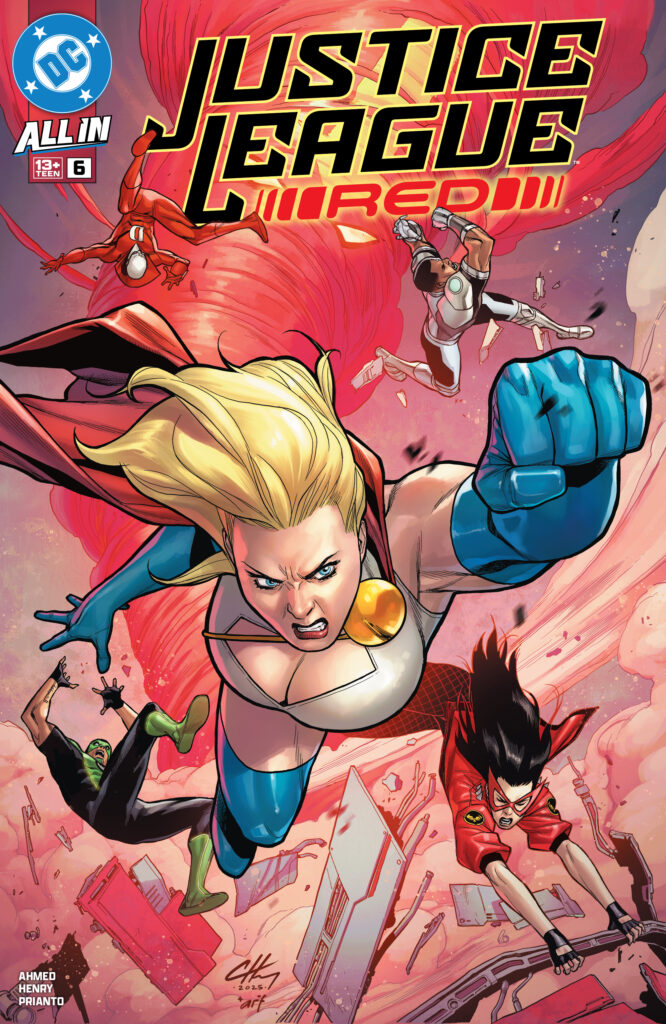
Before diving deeper into the issue itself, the covers for this final chapter deserve recognition. The main cover by Henry and Prianto explodes with momentum as Power Girl charges directly toward the reader, fist extended, creating a visceral, collision-course energy. Her teammates spiral behind her while a violent red tornado threatens to consume everything in its path. The composition feels unstable and urgent—perfectly mirroring a story where tensions are high and the stakes are rapidly escalating.
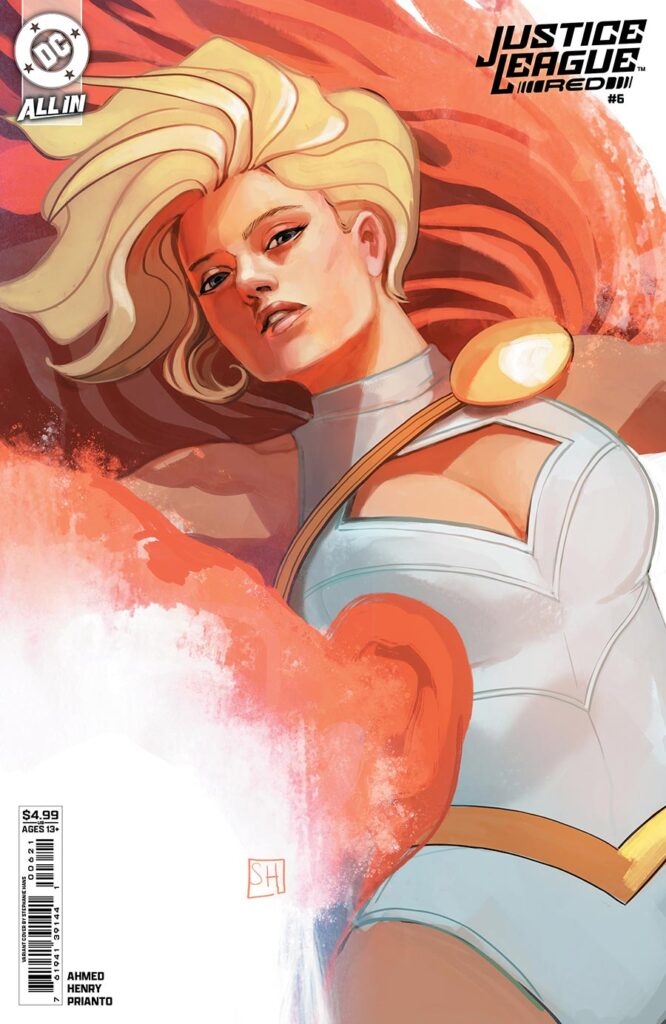
Stephanie Hans’ variant cover takes a dramatically different approach. Stripping away chaos and spectacle, it centers entirely on Power Girl in a calm yet commanding pose. The softer color palette and flowing cape convey confidence, control, and resolve rather than raw aggression. It’s a powerful contrast to the standard cover, proving that Power Girl doesn’t need explosive action to project authority—her presence alone is enough.
As a creative team, Ahmed, Henry, and Prianto delivered consistently strong work throughout this series. The writing was sharp, the character voices distinct, and the artwork energetic and expressive. The central mystery surrounding the end-of-the-world scenario kept me engaged from issue to issue. However, a single narrative decision in this final installment undercut much of that goodwill. A late reveal strongly implies that the long-teased mystery is directly tied to an ongoing DC event. That revelation feels misleading—especially since this series was never clearly marketed as a tie-in. In an era where event connections are typically labeled upfront, that omission weakens the narrative promise Justice League Red initially made to its readers.
That disappointment stings because the potential here is undeniable. The final page—featuring two major powerhouse heroes—feels less like a conclusion and more like the opening chapter of a much larger story we may never get to see. Ideally, this series would have thrived outside of main continuity, free to define its own rules and consequences. Alternatively, it could have launched ahead of the current DC event and been given enough room to meaningfully intersect with it, allowing this team’s actions to play a defining role in the broader outcome.
Final Verdict
(9/10) Justice League Red #6 delivers the resolution it promises, but not the one this team truly deserved. Even so, the strength of the concept, the chemistry between characters, and the clear creative confidence behind the book elevate the series well above most short-run team titles. I sincerely hope this is not the last we see of Justice League Red—and that the original creative team is given the time and space to fully explore these characters, their dynamics, and the personal frictions that make them compelling.
I genuinely enjoyed this series—and that’s exactly why I want more. I want to see these heroes in their civilian lives, dealing with friends, family, and everyday problems alongside world-ending threats. I want deeper explorations of why they clash, why they connect, and why they still choose to fight together. This team deserves another chance to tell its story. Given the opportunity, Justice League Red could grow into something truly special—and that potential alone makes it worth revisiting.